Wednesday, May 12, 2021
Seflie with Mickalene Thomas
Tuesday, May 11, 2021
Final project
For my final project I wanted to use conceptual portraits to convey how the male gaze is not only enacted under patriarchal social standards, but how I contribute to maintaining the male gaze. I was inspired by Ana Mendieta's use of close shot photography of herself, twisting her features to express a separation of her body from a social tool of race and gender. She sees her body more in relation to the land, a sense of origin and functionality. Both connect her to her Cuban-American roots. She embraces her femininity while exploring the boundaries of gender.
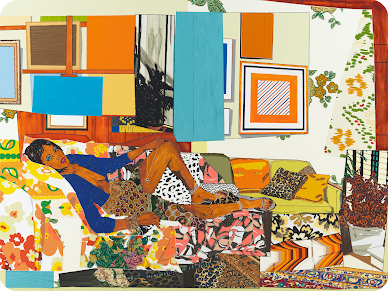
Another artist that inspired my final piece was Mickalene Thomas, who uses rich colors, patterns, and textures to convey her relationship to femininity and race in her portraits of black women. I referenced her bold color tones and pattern choices when painting my own image on my face. My favorite of her works was Le déjeuner sur l’herbe: les trois femmes noires, which is a reference to a famous french painting depicting a naked woman having a picnic in the park with two fully clothed men. The scenes’ absurdity of one naked woman among clothed men is overlooked. She has become an object of the spectacle of the male gaze. Mickalene Thomas’ portrait depicts three black women looking back at the viewer as if interrupted, turning the gaze back onto the viewer. This portrait reminded me that just because I’m a woman aware of the standard of our visual and sexual society has objectified our bodies, does not make me exempt from also perceiving people through the male gaze.
How we see each other and ourselves in relation to each other ultimately controls our reality. Media plays into this by carefully controlling what and how we see within our society. This is known as the spectacle according to Guy Debord, a French philosopher. “The spectacle is not a collection of images, it is a social relation between people that is mediated between images.”(the society of the spectacle).
This absolutely includes myself and how I present my own femininity to be perceived by others. To convey this concept in my self portrait, I used pink and blue acrylic paint to represent male (gaze) and female (in the context of the male gaze) because the two colors are very universally used for gender. The base color is pink to show how I present myself in gender conforming femininity. (meaning I make myself appeal to the male gaze). My own internalized male gaze is shown in both the blue paint on my forehead where the mind's eye is typically depicted, and surrounding my eyes, which I wanted to emphasize with lines and dots emanating around each eye.
When photographing myself, I ended up taking head on pictures to show both confronting myself and the viewer on our own contribution to the male gaze. In an interview Mickalene Thomas said “To see yourself and for others to see you is a form of validation and I'm interested in that very mysterious mystical line that is how we relate to each other in the world” (ARTINFO interview).
This final project is different from my first self portrait projects because I took a lot more liberties in presenting the themes in my pictures as my own rather than replicating the works shown. I believe that I pushed myself not only in the class, but as an art major I was given the opportunity to explore more styles and techniques with less pressure of technicality. I feel more confident to push my own creative boundaries in future works.
ARTINFO interview: https://www.youtube.com/watch?v=i2tJKAfyVhs
The society of the spectacle pt. 1: https://www.youtube.com/watch?v=HsHtSPub3w8Monday, May 10, 2021
SELF-PORTRAIT FINAL PROJECT
The subjects for my final project are self- identity, self-love and trauma. During my years of taking art due school, I have never been the best a painting nor drawing and for me the best way for me was to create a collage mixed with painting (I tried my best). While creating this piece I was stuck due all the ideas I wanted to be represented as final project. When I finally had a clear idea of what I wanted was easy to put it into fragments in the canvas. My major inspiration was Mickalene Thomas, her art is based of black female identity, celebrity, and sexuality. Which gave me an idea, her usually style is black female identity, but I instead painted a woman in red as for me it means passion/love in my life, that woman in the sofa is me. The sofa, I decided to paint black, as the trauma, depression & isolation I went through. The pillows are green as for me it meant hope. And this is the story of my life, I grew up in a loving household raised by my grandparents which taught me how to love two strangers that I called “mom” and “dad”. Always judged my grandparents decisions and though them raising me it was going to be the best idea. Due their immaturity and hate to each other, they ended up creating an emotionally unstable person. The two pillows as they mean hope and I drew them as my grandparents because of them they help me to move on and became the person I am today. The background has a lot of meaning, the right side has a meaning as the younger version of me tried to run away to set herself free from all the pain she felt during her childhood. The left side is more of a physical appearance, everyone has their beauty in their own way. Beauty doesn’t mean a certain shape, color, type of eyes or a certain race. “Beauty Is In The Eye Of The Beholder” and I always keep that in mind. During my first self-portraits and this self-portrait there’s more confident on my work and what I am doing so far. Learning to all the artist during this semester has taught me that everyone has a different way of expressing art and whoever isn’t happy oh well. I have learned that even media kind of controls the way we want to see ourselves because that’s how “it is support to be” for example, stretch marks, body hair, gaining weight and others, are topics that a lot of people need to fix themselves because in the eyes of others it is not acceptable. Happiness should be your priority before unwanted comments from strangers.
Quotes
Ways of seeing by John Berger
“To be born a woman has been to be born, within an allotted and confined space, into the keeping of men. The presence of women has developed as a result of their ingenuity in living under such tutelage within such a limited space. But this has been at the cost of a woman's self being split into two. A woman must continually watch herself.” (chapter 3, pg. 46)
When Artists Create Flags
“She explores the potential made possible through our own mutual cooperation. Possibly holding a piece of the sky, these birds remind us that we must work together.”
Susan Sontag- On Photography
“To collect photographs is to collect the world.”
Final Self-portrait
Discovering myself
“I think that little by little I’ll
be able to solve my problems and survive.”
“She had the courage to be unique…
she was able to be free”
“He said you have talent.”
“Over the centuries links have been
asserted between the shape of the head, or eyebrows, lips, ears, fingers, and
the counterpart characteristics of intelligence, character, moral rectitude,
perversity and criminality.” (the art of self-invention p.123)
“Seeing comes before words. The child looks and recognizes before it can speak.” (Ways of seeing p.7)
“An image is a sight which has been
recreated or reproduced.” (Ways of seeing p.9)
Inspired by Frida Kahlo, she went
through an accident that damaged her spine and gave her multiple fractions that
made her incapable of moving and forced her to stay at her house, sitting on
her chair for a long time. That long time inspired her to start painting.
During this period most of her paintings were portraits using a mirror in her
room.
During this last year of the
pandemic, I felt just like Frida that I am trapped, and I need to spend my time
on something precious, she inspired me to focus more on discovering myself and
appreciating the things I have, which sometimes I do not even notice they
exist. Knowing more about Frida made me start thinking about my identity, my
family, my friends, places I love to visit, outings and gatherings, worshiping,
and an endless list of things that formed who I am.
Frida used painting to express
herself, to discover who she was, and set her soul to be free. For me, I was
thinking about who I am when I looked into my mirror, what are the things that
formed my personality and identity. Then, I started doodling my thoughts and
searching for my old pictures and go through my memories searching for what
made me happy in the past. I choose pictures of things that Identify me also, I
chose what I missed during the pandemic and hoping that I can get it back soon.
At that moment, I have put everything together in graphic prints and collages.
I, then, sat in front of a mirror and highlighted my face with my collected
prints.
I noticed my self-portrait for the
final project is hugely different from my first three self-portraits. At the
beginning of this class, I always wanted to choose portraits that did not show
my face. I wanted portraits that can least showed me and my facial expressions,
my favorite was the ones that showed me from further and showed the least
possible details. Though, for my final self-portrait, I chose a portrait that
highlights my face. I wanted to show who I am.
Citation:
·
Hollywoodstreams, director. Salma Hayek in 2002 -
Frida Interview. YouTube, YouTube, 30 Apr. 2009,
www.youtube.com/watch?v=y1R0T5MOR2s&t=18s.
·
Frakdox, director. Frida Kahlo Biography - (2 of 6).
YouTube, YouTube, 20 Jan. 2009, www.youtube.com/watch?v=SH_S3nAPTdY.
·
Berger, John. Ways of Seeing. BBC and Penguin,
1972.
·
Finkelstein, Joanne. The Art of Self Invention:
Image and Identity in Popular Visual Culture. I.B. Tauris, 2007.
· Dunne, Carey. “The Photographed, Collaged and Painted Muses of Mickalene Thomas.” Hyperallergic, 5 Mar. 2016, hyperallergic.com/278045/the-photographed-collaged-and-painted-muses-of-mickalene-thomas/.
- -, Flavia Medrut, et al. “17 Frida
Kahlo Quotes to Inspire You to Turn Pain Into Beauty.” Goalcast, 8 Apr.
2021, www.goalcast.com/2017/11/28/17-frida-kahlo-quotes/.
Final Self- Portrait
My final project is a relationship between media and the consumer. I got inspiration from the Society of the Spectacle. In today’s digital and mass marketing age, headlines are everywhere we look, from our timelines, news applications, billboards, advertisements, and magazines. Headlines and titles are what capture our attention and will help in the decision of whether we click or not. Headlines themselves can also play a part in how the article is interpreted, eye-catching or shocking headlines will capture an audience’s attention that will cause them to think before they read anything in the body of an article. Many times on our timelines, people share their thoughts or opinions on articles and papers they have not read, solely based on the headline or title. I chose to paint and collage as a medium because it allowed me to incorporate headlines and article titles into my work.
Society of a Spectacle encouraged my decisions in this piece. The black and white crowd photo displays uniformity and creates a relationship between the individuals in the crowd. They all sit in rows to observe the same subject. In this case, this crowd of individuals is watching headlines, in a similar way that we would. Each person is their own individual being, but they all still watch the same thing. The same way our timelines have their own algorithms, but we always see the same headlines.
A major influence on the changes was the readings and the artist we studied. Mickalene Thomas collaged together photos of black women to share their personal stories, instead of the narratives that have been produced from media. "By portraying real women with their own unique history, beauty and background, I’m working to diversify the representations of black women in art". Amy Sherald wants the insert herself into the world and focuses on painting black people in colorful environments, "It does in light of the artist’s drive to, in her words, seek “versions of myself in art history and in the world.”. The Society of the Spectacle helps tie in Thomas and Sherald because it gives an explanation to how these representations and creates this “reality”. “Images influence our lives and beliefs on a daily basis; advertising manufactures new desires and aspirations.”
Media and its images have a major influence on identity and self-presentation. These major companies put out advertisements, sponsored videos, create movies, and form this ideal lifestyle that the consumer should want to live. Media forms this “reality” and pumps it to the public everywhere, which influences people to conform to it. This desired lifestyle is fed to the public everywhere so much that it becomes our conversations and starts to develop into the “normal”. The Spectacle helps explain how these “realities” affect the identity of a person, “The alienation of the spectator, which reinforces the contemplated objects that result from his own unconscious activity, works like this: the more he contemplates, the less he lives; the more he identifies with the dominant images of need, the less he understands his own life and his own desires”.
Society of a Spectacle encouraged my decisions in this piece. The black and white crowd photo displays uniformity and creates a relationship between the individuals in the crowd. They all sit in rows to observe the same subject. In this case, this crowd of individuals is watching headlines, in a similar way that we would. Each person is their own individual being, but they all still watch the same thing. The same way our timelines have their own algorithms, but we always see the same headlines.
A major influence on the changes was the readings and the artist we studied. Mickalene Thomas collaged together photos of black women to share their personal stories, instead of the narratives that have been produced from media. "By portraying real women with their own unique history, beauty and background, I’m working to diversify the representations of black women in art". Amy Sherald wants the insert herself into the world and focuses on painting black people in colorful environments, "It does in light of the artist’s drive to, in her words, seek “versions of myself in art history and in the world.”. The Society of the Spectacle helps tie in Thomas and Sherald because it gives an explanation to how these representations and creates this “reality”. “Images influence our lives and beliefs on a daily basis; advertising manufactures new desires and aspirations.”
Media and its images have a major influence on identity and self-presentation. These major companies put out advertisements, sponsored videos, create movies, and form this ideal lifestyle that the consumer should want to live. Media forms this “reality” and pumps it to the public everywhere, which influences people to conform to it. This desired lifestyle is fed to the public everywhere so much that it becomes our conversations and starts to develop into the “normal”. The Spectacle helps explain how these “realities” affect the identity of a person, “The alienation of the spectator, which reinforces the contemplated objects that result from his own unconscious activity, works like this: the more he contemplates, the less he lives; the more he identifies with the dominant images of need, the less he understands his own life and his own desires”. Society of a Spectacle encouraged my decisions in this piece. The black and white crowd photo displays uniformity and creates a relationship between the individuals in the crowd. They all sit in rows to observe the same subject. In this case, this crowd of individuals is watching headlines, in a similar way that we would. Each person is their own individual being, but they all still watch the same thing. The same way our timelines have their own algorithms, but we always see the same headlines.
A major influence on the changes was the readings and the artist we studied. Mickalene Thomas collaged together photos of black women to share their personal stories, instead of the narratives that have been produced from media. "By portraying real women with their own unique history, beauty and background, I’m working to diversify the representations of black women in art". Amy Sherald wants the insert herself into the world and focuses on painting black people in colorful environments, "It does in light of the artist’s drive to, in her words, seek “versions of myself in art history and in the world.”. The Society of the Spectacle helps tie in Thomas and Sherald because it gives an explanation to how these representations and creates this “reality”. “Images influence our lives and beliefs on a daily basis; advertising manufactures new desires and aspirations.”
Media and its images have a major influence on identity and self-presentation. These major companies put out advertisements, sponsored videos, create movies, and form this ideal lifestyle that the consumer should want to live. Media forms this “reality” and pumps it to the public everywhere, which influences people to conform to it. This desired lifestyle is fed to the public everywhere so much that it becomes our conversations and starts to develop into the “normal”. The Spectacle helps explain how these “realities” affect the identity of a person, “The alienation of the spectator, which reinforces the contemplated objects that result from his own unconscious activity, works like this: the more he contemplates, the less he lives; the more he identifies with the dominant images of need, the less he understands his own life and his own desires”.
Society of the Spectacle- Guy Debord's
Mickalene Thomas- Mickalene Thomas -Photographed, Collaged, and Painted Muses
Amy Sherald- The Amy Sherald Effect
"Lady In Red" Final Selfie Project
My project is a self portrait inspired by Amy Sherald. She was the first artist I thought of when I received this project. From the first time she was introduced to us in class, I was intrigued by her and her art style. I love how the backgrounds of her paintings embrace the melanin of her inspirations. She really embraces the fact that Black is Beautiful. I particularly love how simple yet detailed her pictures are. The more you look at them the more things you notice about it.
In the painting I chose to recreate, it looks like a regular orange background with a black woman on it but as you keep looking you notice the red in the background, the kinks in her afro, the definition in her arms and the details in her dress. I absolutely loved this piece. When I was deciding how to recreate it I thought about what picture of mine resembled the piece the most. After scrolling through my Instagram I found this picture I took about 2 weeks ago and it was perfect.
What I used to create my project was oil pastels on canvas. I initially wanted to use acrylic paint but the ones I purchased ended up being too light. This was the first time I worked with oil pastels and it was honestly so fun. The creaminess of the pastels made it very easy to blend and work with. For the background I used three different colors and for the dress I used two. I chose to make the background blue because I wanted the color of my dress and skin to pop.I wanted it to convey the message of through all the darkness I will shine bright and be as colorful as I could be.
In my first self portrait I utilized my body, physical objects and black and white. In my final project I wanted to do a more cartoon feel with vibrant colors. I also wanted to challenge myself to use a tool that I never used before. I also challenged myself to blend. It was a technique that I always found very difficult but I wanted to explore it since it was my final project. I have also always found it hard to do faces and facial expressions but Amy Sherald made me want to try. My absolute favorite part of my interpretation is my dress. I feel like the dress is so well blended and it represents my dress well.
Quotes:
Carrie Mae Weems “Kitchen Table Series”
“But it was also a seminal moment for Black representation in art, influencing an entire generation of artists who rarely saw their own selves reflected back on museum walls”
Mickalene Thomas -Photographed, Collaged and Painted Muses
“By selecting women of color, I am quite literally raising their visibility and inserting their presence into the conversation,


