“It is a testament to her belief that, like street theater or religious rituals, art can nudge viewers towards congregation.” (Wangechi Mutu).
“The spectacle reduces reality to an endless supply of commodifiable fragments, while encouraging us to focus on appearances. For Debord, this constituted an unacceptable “degradation” of our lives.” (The society of the spectacle)
“In addition the notoriety of this image demonstrated that appearances are ambiguous and easily appropriated, that they can easily be converted from challenges to the status quo into techniques that sustain it.” (Finkelstein pg. 188)
“The connections of personality and identity with material objects also make us into commodities. Celebrities endorse and embody specific products and lifestyles. Behind the familiar faces and endorsed prod- ucts are invitations to self-invent. The Hollywood movie star, sports hero and pop idol are advertisements for various material goods as well as abstract personal qualities.” (Finkelstein pg 206)


My selfies are inspired by Andy Warhol. Warhol used bright colors and repeated images in his art. I always loved pop art, I think it is very beautiful. I chose these particular pictures to show my way of self care by showing me in a happy state of mind. Self care isn’t just worrying about the physical things. I took these pictures at the beach. I was having a bad week so I decided to head to the beach and just relax with my friend. The beach truly is a great place to relax my mind and bring me happiness.
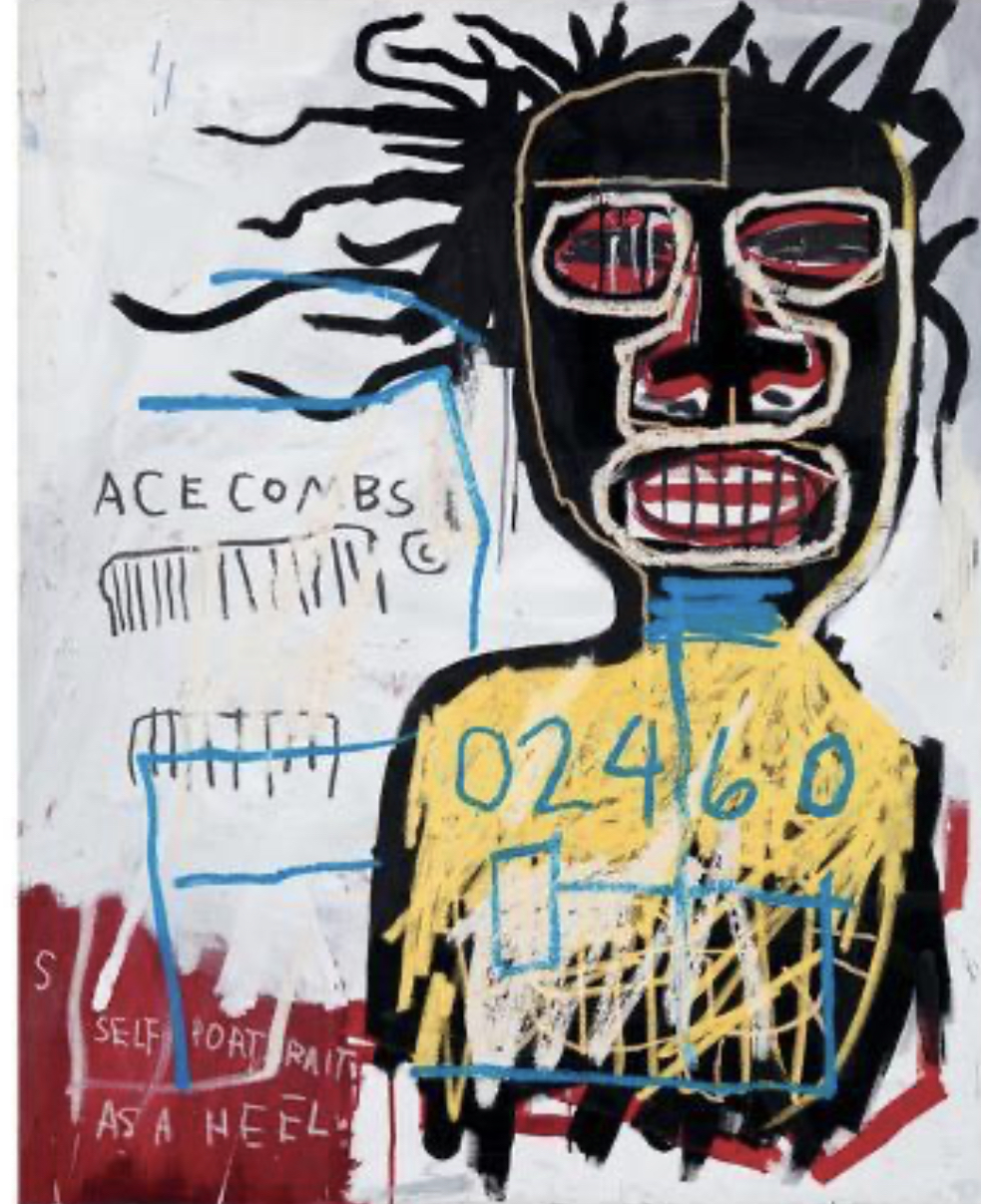
My self portrait “Z in a New Light" was inspired by Jean Michel Basquiat. I chose him because I loved that he always incorporated and embodied his culture, background, and values in his pieces. He always gave homage to his African American roots and he viewed that part of him as royalty. I also chose him because I knew creating a self portrait in his art style would challenge me. I wanted to view and portray myself in a way that I would have never thought to. In addition to that, this class made me want to explore my identity more. I felt that drawing myself in a different light would help me explore myself on a deeper level. I’ve always been very particular with my image and the way I make myself look to others. I always wanted to be the “perfect girl” , the “pretty girl” but with this piece I found that there is beauty in the unorthodox. The colors that I chose to use in my piece represent me and my fashion because it was vibrant and completely random. Usually when people get dressed they have an “aesthetic”. An aesthetic in fashion is basically your style or your taste. I don’t have one. I go with what I feel and let it make something beautiful. I know the self portrait I created shows that. I didn’t have a set color scheme when I colored it. I let the markers speak to me and I put it on paper. Naturally, at first I thought it had to be perfect with straight lines and such but that’s not what Basquiat represented. He emphasized the beauty in being imperfect. The jagged lines and the uneven shapes is what made his pieces so amazing. When creating my piece I solely focused on recreating his “Self Portrait As a Heel”. It was so simple but so beautiful to me. I wish I could paint like he did but the markers that I used gave me the result that I was aiming for.
Finkelstein, Chapter 5 Fashion :
" Looking at fashion is more than observing the predominance of highly promoted luxury goods, extravagant patterns of consumption and celebrity endorsements of leisure activities and lifestyles." page 213
2-More recent (2016) article in Hyperallergic Magazine:
" Which is more important, the expression of the feeling itself, or the knowledge that it will be documented and seen by others?"
" It is the advertisements plastered on the subway and the pop-up ads that appear in your browser. It is the listicle telling you “10 things you need to know about ‘x.”“The NewOnes, will free Us,” they represent, for Ms. Mutu, “words that we haven’t heard, people we haven’t noticed. They will be our redemption.”
Wangechi Mutu: A Fantastic Journey
 |
| Amy Sherald "There is no charm equal to tenderness of heart" (2019) |
 |
| Andy Warhol "Marilyn Monroe" (1967) |
 |
| Dominique Holley "Self- Representation in Media" (2021) I used Amy Sherald and Andy Warhol as inspiration for my self-portrait collage. Amy Sherald's work displays black women and men to help insert them into the art world. She usually paints vibrant backgrounds which creates a contrast against the darker she uses to paint black people. Andy Warhol's work has themes based on celebrities. He has many works that are based around famous people. For my project, I used cutouts from magazines are based on fashion, trends, and celebrities. These magazines often have many advertisements that are used to influence their audience to buy things. Amy Sherald inspired me to use the black women found in these everyday magazines to create a contrast on the bright background. Andy Warhol's celebrity themes made me focus primarily on how black famous women are depicted in media. As a young black woman, it is important to see how people like me are presented in society. It is also inspiring to young black women and girls to see people like them receiving highly recognized rewards and breaking barriers. An Illustrated Guide to Guy Debord's 'The Society of the Spectacle'Images influence our lives and beliefs on a daily basis; advertising manufactures new desires and aspirations. Wangechi Mutu: A New Face for the Met"in classical African art, the female body in some instances is the museum — she is where the art is placed." Finkelstien Chapter 5 "Fashion""Fashion is a system of classification that engages the imagination and trains us to recognize the symbolic impact of material goods" (195) "It is more difficult in the twenty-first century to trust the links between appearances and character, despite the connection being regularly reiterated" (207) |


An Illustrated Guide to Guy Debord’s ‘The Society of the Spectacle’:
·
The Spectacle is not a collection of
images, but a social relation among people, mediated by images.
·
The media interprets (and reduces)
the world for us with the use of simple narratives.
·
“The Spectacle presents itself as
something enormously positive, indisputable and inaccessible. It says nothing
more than ‘that which appears is good, that which is good appears,’”
·
Gradually, we begin to conflate
visibility with value. If something is being talked about and seen, we assume
that it must be important in some way.
Wangechi Mutu: A New Face for the Met:
·
“remembers as a little girl having
to take a secret oath to promise never to be a traitor. There was killing,
there was cruelty, and there were foreigners telling your elders what to do, ”
Ms. Mutu continues.
Wangechi Mutu: A Fantastic Journey
·
Mutu
encourages audiences to consider these mythical worlds as places for cultural,
psychological, and socio-political exploration and transformation.
I give my collage the title of “Self-appreciation”. I used paper collage
to collect the background. Andy Warhol and Kehinde Wiley were my inspirational
in my project. Looking at their portraits I felt like, they are trying to highlight
the personality more than the look, the only thing that really matters is your
identity. No one is supposed to be ashamed of who they are.
I made the background in color referring to how life can get busy,
and we do not know which direction we should follow. On the other hand, I changed
my picture to black and white as a way to express that I should never loose my
identity and always define myself even in the middle of the darkest days.
Work
cited:
·
Princenthal,
Nancy. “Wangechi Mutu: A New Face for the Met.” The New York Times, The
New York Times, 5 Sept. 2019,
www.nytimes.com/2019/09/05/arts/design/wangechi-mutu-metropolitan-museum.html.
·
“Wangechi
Mutu: A Fantastic Journey.” Brooklyn Museum: Wangechi Mutu: A Fantastic
Journey, www.brooklynmuseum.org/exhibitions/wangechi_mutu/.


Susan Sontag: On Photography
“The picture may distort; but there is always a presumption that something exists, or did exist, which is like what’s in the picture”
“While a painting or a prose description can never be other than a narrowly lective interpretation, a photograph can be treated as a narrowly selective transparency.”
Revisiting Carrie Mae Weems Landmark “Kitchen Table Series” by Jacque Palumbo for artsy
“Everyone can relate to this work”
“It’s not just black women; it’s white women, Asian women. Men can see the women in their lives- memories from their childhood or scenes from their marriage or their family life. It’s so universal and yet representation like this is so rare”
The Cindy Sherman Effect by Phoebe Hoban for ArtNews
“ Shermans coup was to cast her self as subject matter, making each of her staged characters the star of an implicit narrative, from the lush color centerfolds that followed the “film stills” in 1982, to the strangely sexualized “broken dolls” of the ‘90”
“ there is a whole new crop of artists whose sensibility has been shaped by the Internet and social media, major influences that didn’t even exist when Sherman first began her photographic odyssey”